
A phone, a headlamp, and a camera can run all weekend on a pocket sized power bank. A portable fridge, an electric kettle, or a laptop that needs a wall outlet is a different job, and that is where a portable power station earns its weight. Both devices store energy and hand it back over USB, but they are built for different loads, and picking the wrong one usually shows up on the first night at camp.
As an Amazon Associate, Outwatt earns from qualifying purchases made through links on this page, at no extra cost to you. The products below are examples with published specifications, not a tested ranking.
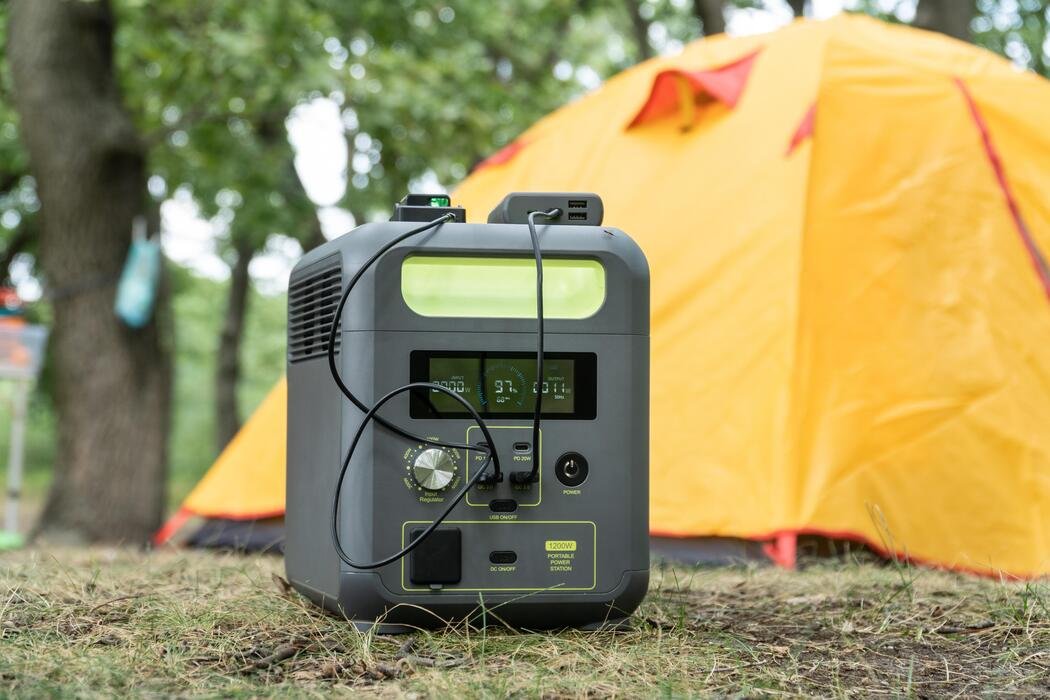
The core difference: size of the battery and type of outlet
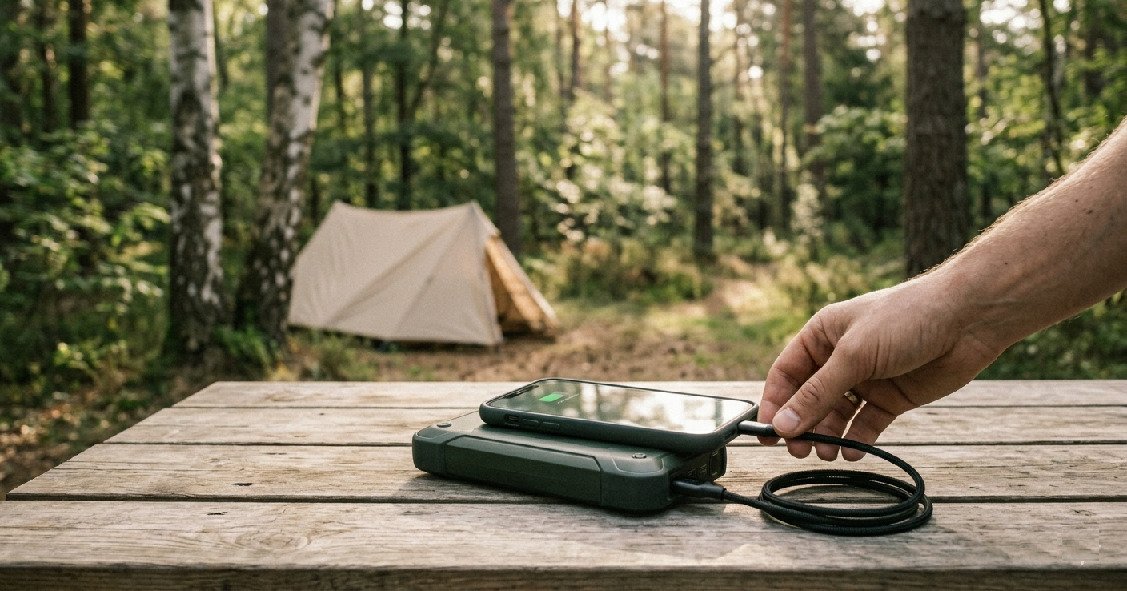
A power bank is a flat battery with USB ports. You charge it from a wall outlet or a USB charger, slip it into a pocket or a pack lid, and use it to top up phones, headlamps, earbuds, and other small USB gear. Its capacity is usually listed in milliamp hours, or mAh, and most camping models sit between 10,000 and 27,000 mAh. Converted to watt hours, the unit power stations use, that is roughly 37 to 100 Wh.
A portable power station is a much larger battery with an inverter, which turns stored DC power into household AC power. That inverter is the real difference. It gives you standard wall style outlets, plus USB ports and often a 12 volt car style outlet, so you can run gear that was designed to plug into a wall. Stations range from compact models near 250 Wh up to units above 1,000 Wh, and they weigh several pounds at minimum. You carry one to a campsite, not in a jacket pocket.
The practical split is simple. If everything you own charges over USB and sips power, a power bank covers it. If any item on your list needs an AC outlet, or draws more power than a USB port can deliver, you need a station, or you need to leave that item at home.
Capacity in plain terms
Capacity tells you how much energy the battery holds. Watt hours are the honest way to compare across product types, because mAh alone hides the voltage behind it. A 24,000 mAh power bank at the 3.7 volts its cells run at holds about 86 Wh. A 256 Wh station holds roughly three times that. A 1,070 Wh station holds roughly twelve times that.
To estimate runtime, divide the watt hours by the watts your device draws, then expect a shorter result in real use. An inverter loses some energy as heat, and a fridge cycles on and off rather than drawing a steady load, so published watt hour figures are a ceiling, not a promise. A 60 watt portable fridge on a 256 Wh station will not run for a neat four hours, because the fridge does not draw 60 watts every minute, and the station does not hand over every stored watt hour. Use the math to compare models, then leave margin for a cold night or a second device.
For phones, the math is friendlier. A phone battery holds roughly 12 to 18 Wh, so even a mid sized power bank can recharge one several times. That is why a power bank feels generous on a hiking trip and suddenly small at a drive up campsite where a fridge, lights, and a laptop all want power at once.
Outlets decide what you can run
Count the ports before you count the watt hours. A power bank gives you USB-C and USB-A, and a strong model can push 140 watts through one USB-C port, which is enough for many laptops. What it cannot give you is an AC outlet. A device with only a wall plug, like many electric kettles, CPAP machines with AC adapters, and some camera battery chargers, simply has nowhere to plug in.
A power station solves that with AC outlets, but the outlet count and the total output limit matter as much as the battery size. A station rated for 300 watts continuous can run lights, phones, a camera charger, and a small fan at the same time, but it will shut down or refuse a 1,000 watt kettle. A station rated for 1,500 watts continuous can handle that kettle and a portable fridge together, as long as the combined draw stays under the limit. Check both the continuous rating and the surge rating, since motors briefly draw more than their running watts when they start.
Also check how many devices you plan to run at once. Two USB ports look fine until a family of four all need a charge after dinner, and a single AC outlet gets crowded fast when a fridge, a lantern charger, and a laptop compete for it. For more on sizing the charging side of a trip, see our guide to solar panel wattage for camping.
Weight and packing: the real trade off
This is where most buyers feel the decision. A high capacity power bank weighs about 1.4 pounds and disappears into a pack. A compact 256 Wh station weighs about 7.7 pounds, roughly the weight of a small cooler, and needs its own corner of the car or a dedicated spot in a tent vestibule. A 1,070 Wh station weighs about 23.8 pounds, which is a two handed carry from the car to the picnic table.
For backpacking, the answer is usually settled by weight alone. A station stays in the car, and a power bank goes on the trail. For car camping, the station wins on usefulness, because weight stops mattering once the car does the carrying. For a mixed trip, many campers carry both: a station at base camp for the fridge and evening charging, and a power bank in the daypack for phones and a headlamp on the trail.
Pack shape matters too. Power banks are flat and easy to tuck into a pocket. Stations are boxes with handles, vents, and a display, and they need airflow around them while charging and discharging. Do not bury a station under sleeping bags while it runs, and keep both types dry. A wet charging port is a trip ender for either device.
Recharging at camp
Both types recharge from a wall outlet before the trip, and both can recharge from solar panels or a car outlet at camp, but the speed gap is wide. A large power bank can refill from a 140 watt USB-C charger in a couple of hours at home. A station can take much longer from a car outlet, which is usually limited to about 100 watts, while a wall outlet refill can take around one to two hours on models with fast AC charging.
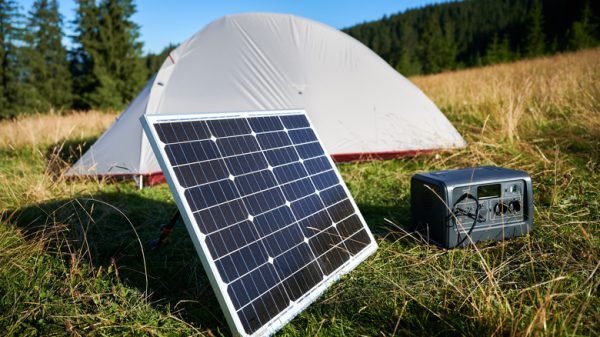
Solar input limits decide whether panels can keep up. A compact station may accept only about 110 watts of solar, while a larger model may accept up to 400 watts. That ceiling, plus real sunlight, sets how much energy you recover each day. A panel rated at 100 watts rarely delivers 100 watts all day, so plan on partial refills rather than a full recharge from a single panel. If solar charging is part of your plan, match the panel wattage to the station input limit before you buy either piece.
Three products that show the range
The three models below are not a ranking. They show how capacity, output, and weight move together, from pocket charger to base camp hub.
| Model | Capacity | Continuous AC output | Weight |
|---|---|---|---|
| Anker 737 power bank (PowerCore 24K) | 24,000 mAh (86.4 Wh) | None (USB only, 140 watts max over USB-C) | 630 grams |
| EcoFlow River 2 | 256 Wh | 300 watts (600 watts surge) | 7.7 pounds |
| Jackery Explorer 1000 v2 | 1,070 Wh | 1,500 watts (3,000 watts surge) | 23.8 pounds |
The Anker 737 power bank is the trail option: 24,000 mAh, or 86.4 Wh, with up to 140 watts from a single USB-C port and a total of two USB-C ports plus one USB-A port. It charges laptops, phones, and tablets, and at 630 grams it fits a pack lid. Check price on Amazon.
The EcoFlow River 2 is the small station: 256 Wh, 300 watts of continuous AC output with a 600 watt surge, a lithium iron phosphate battery rated for 3,000 cycles to 80 percent capacity or more, and a full recharge from AC in about 60 minutes per EcoFlow. It suits lights, phones, a camera charger, and small fans, and its 7.7 pound weight is manageable for one person. Check price on Amazon.
The Jackery Explorer 1000 v2 is the base camp option: 1,070 Wh, 1,500 watts continuous AC output with a 3,000 watt surge, three AC outlets, and a lithium iron phosphate battery rated for 4,000 cycles to 70 percent capacity. It can run a portable fridge plus higher draw gear, accepts up to 400 watts of solar input, and weighs 23.8 pounds, so it belongs in car camping rather than a backpack. Check price on Amazon.
Notice what the table hides: the bank has no AC outlet at any price, and the stations cost far more weight per watt hour as capacity grows. That is the trade in one glance.
Which one fits your trip
Weekend backpacking or fast and light travel
Take a power bank, and size it by phone charges rather than watt hours. A 20,000 to 24,000 mAh bank covers several days of phones, a headlamp, and a camera for most people. Leave the station behind, and if you need camp lighting, pick efficient lights: our guide to camp lantern types, lumens, and runtime explains how brightness and burn time relate.
Car camping with a fridge or electric cooking
Take a station, and size it from your biggest load. Add up the watts of everything that must run at the same time, then pick a station whose continuous output clears that total with room to spare. A portable fridge changes the math more than any other item, so read our explainer on portable fridge power draw before choosing a capacity. Bring a power bank too, for the trail and for nights when the station stays at the car.
Family base camp or group trips
Take the larger station and treat it as shared infrastructure. One 1,000 Wh class station with several outlets beats three small banks when a group needs lights, cooking gear, and device charging from one spot. Set a charging order for the evening, fridge first, then lights and phones, so a low battery never surprises you at bedtime.
Emergency backup at home
A station also works as a home backup for short outages, powering phones, lights, and a router, while a power bank is only a phone charger with extra steps. If outages are part of your planning, the station is the honest pick, even if it never leaves the garage except for camping trips.
What to check before you buy
Start with the plug list. Write down every device you will bring, its charging port, and its watt draw if it uses AC power. If the list is all USB, a power bank probably covers it. If one item needs AC, a station enters the picture, and its continuous output must clear that item plus anything running at the same time.
Next, check battery chemistry and cycle life. Lithium iron phosphate batteries are rated for thousands of cycles, often 3,000 to 4,000 to a stated share of original capacity, while older lithium ion cells are usually rated lower. Cycle ratings are manufacturer figures, and real life depends on heat, depth of discharge, and storage, but they are still a useful comparison between models.
Then check recharge options. Confirm the solar input limit, the car charging wattage, and the wall charging time, and confirm you own, or plan to buy, cables that match. A station with a 400 watt solar limit gains little from a 100 watt panel, and a power bank with a 140 watt output needs a cable and a charger rated for that power to reach it.
Finally, check the details that cause returns: whether the unit has a quiet mode or a fan that runs under load, whether the display shows remaining watt hours or only a percentage, whether the AC outlets are pure sine wave, and whether the warranty and support match how hard you will use it. A station that hums all night beside a tent is a different product than the same specs on paper.

The short version
A power bank is the right tool when everything charges over USB and weight matters. A power station is the right tool when anything needs an AC outlet, or when a fridge, a kettle, or a group of devices must run from one box. Many campers end up with both, and that is not a failure of choosing. It is the shape of the job: a small battery for the trail, and a larger one for camp. Buy for the biggest item on your list and the heaviest load you will run at once, leave margin in both capacity and output, and check the published specs rather than the marketing headline before you spend.
For the rest of the camp power picture, compare the products above with the second links in the table: Check price on Amazon (Anker 737 power bank), Check price on Amazon (EcoFlow River 2), Check price on Amazon (Jackery Explorer 1000 v2).